
Colin Powell, the first black American secretary of state, whose leadership in several Republican governments of American foreign policy in the late 1920s was 84 years old.
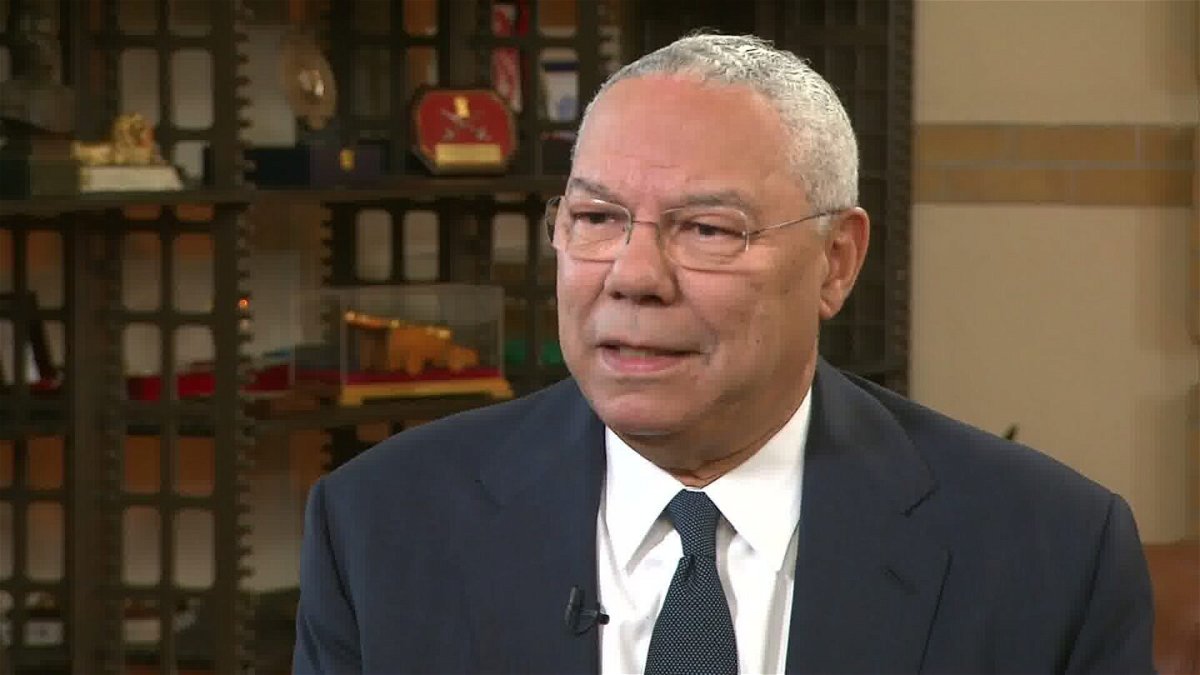
"General Colin L. Powell, former US Secretary of State and Chairman of the Joint Chiefs of Staff passed away this morning due to complications from Covid 19," the Powell family wrote on Facebook, noting that he was fully vaccinated.
Powell had multiple myeloma, a plasma cell cancer that suppresses the body's immune response, as well as Parkinson's, Peggy Cifrino, Powell's longtime chief of staff, told CNN. Even if they are fully vaccinated against Covid19, immunosuppressed people are at a higher risk of contracting the virus.
"We have lost a husband, father, grandfather, and an extraordinary and loving great American," the family said.
Powell was a respected and pioneering professional soldier whose career took him from combat service in Vietnam to the first black national security adviser at the end of Ronald Reagan's presidency and the first and youngest African-American chairman of the Joint Chiefs of Staff under President George. HW Busch. His national popularity skyrocketed after the victory of the US-led coalition during the Gulf War, and he was at times considered one of the top contenders for America's first black president in the mid-1990s. But his reputation would be forever stained when George W. Bush's first secretary of state presented deficient information to the United Nations to defend the Iraq war, which he would later refer to as a "monstrosity" in his files.
Bush said in a statement Monday that Powell was "a great official" who was "a presidential favorite who twice received the Presidential Medal of Freedom. He was highly respected nationally and internationally. And most importantly." family man and friend. "
Although Powell never ran for the White House, when he was sworn in as Bush's Secretary of State in 2001, he was named the nation's highest-ranking black official and was fourth in line to the President
"I think it shows the world what is possible in this country," Powell said of his historiographic nomination during his Senate hearing. "It shows the world that: follow our model and, for a period from our beginnings, if you believe in the values that you represent, you can see things as wonderful as I sat in front of you for your approval."
The point: Republican Colin Powell no longer exists in the Republican Party
Later in his public life, Powell became disillusioned with the GOP's shift to the right and used his political capital to elect the majority of Democrats in the White House, especially Barack Obama, the first black president Powell supported in the closing weeks of the 2008 campaign.
The announcement was seen as a significant boost to Obama's candidacy due to Powell's wide popularity and stature as one. of the most prominent and successful black Americans in public life.
Powell leaves behind his wife Alma Vivian (Johnson) Powell, whom he married in 1962, and three children.
Alma Powell, who is fully vaccinated against the virus, also tested positive for Covid19 this month but showed only mild symptoms, a source close to the family told CNN. She was sent home after treatment at Walter Reed National Military Medical Center.
Cifrino told CNN that Powell was vaccinated early and received his second vaccination in February. He was supposed to get the booster shot last week, but when he got sick he couldn't get it. Covid19 vaccines are very effective in preventing serious illness and death, but no vaccine is 100% effective.
As of October 12, the US Centers for Disease Control and Prevention had reported more than 7,000 cases of Covid19 that resulted in death. At that time, more than 187 million people in the United States were fully vaccinated. That's one in 26,000 fully vaccinated people who died from Covid19 or 0.004%. 4,444 Of these historical cases that resulted in death, 85% were people 65 and older and 57% were men, according to the CDC. 4,444 CDC data also shows that the risk of dying from Covid19 is more than 11 times higher for adults not vaccinated in August than for vaccinated adults. This gap is smaller for older people who are more prone to severe Covid19. For those over 80, the risk of dying from Covid19 in August was around five times higher in unvaccinated people than in fully vaccinated people.
Leaders mourn "A pioneer and role model"
Powell's death was greeted with a wave of grief by past and current leaders, including President Joe Biden, who described Powell as a "dear friend" and a Committed civil servant who broke barriers.
"Colin embodied the highest ideals of both the warrior and the diplomat. Above all, he was committed to the strength and security of our nation. Having fought in wars, he understood better than anyone that military power alone is not enough to maintain ours To maintain peace and our prosperity. " From the perspective of his story, advising presidents and shaping our country's politics, Colin led with his personal commitment to the democratic values that make our country strong. Over and over again he put the country in front of itself, in front of the party, in front of everything else in uniform and out, and that earned him the universal respect of the American people, "said Biden.
Former Vice President Dick Cheney, who served under Bush in Page von Powell said he was "deeply saddened to learn that America has lost a leader and a statesman." General Powell had a remarkably remarkable career and I was fortunate to work with him, "Cheney said in a statement, adding that Powell was a "pioneer and role model" department, I remembered Monday as "a wise man, a man of principle, a loyal friend, and one of the kindest people I have ever met."
"Although we grew up in different contexts, we came together through our family's immigration stories, our deep love for America, and our belief in the importance of public service," he said in a statement.
Condoleezza Rice, who succeeded Powell when he retired in 2005, said Monday that he was "a trusted colleague and dear friend in very difficult times," adding in her own testimony that "much of his legacy is in life. in the countless young lives, it has touched. "
And Antony Blinken, the current incumbent, said Monday that Powell "gave the State Department the best of his leadership, experience, and patriotism."
Defense Secretary Lloyd Austin said in a statement Monday that he "lost a great friend and personal mentor" in Powell.
"He always had time for me and I could always come to him with tough questions. He always had good advice. We will surely miss him," said Austin, who made history as the first Black Secretary of Defense earlier this year.
Professional Soldier
Colin Luther Powell was born on April 5, 1937, in Harlem, New York, to Jamaican immigrants. After growing up in the South Bronx, Powell attended school at the City College of New York, where he attended ROTC, led the precision drilling team, and achieved the highest rank in the Corps, Cadet Colonel.
"I liked the structure and discipline of the military," Powell said in a CNN profile of him in the early 2000s. "I felt a bit distinctive in a uniform. I didn't distinguish myself in a lot of other things."
Joined the US military after graduating in 1958 and then completed two tours in South Vietnam in the 1960s, where he was wounded twice. even in a helicopter crash in which he rescued two soldiers. He remained in the military after returning home, attending National War College, and rising to leadership positions. He was promoted to brigadier general in 1979, named Reagan's last national security adviser in 1987, and chairman of the Joint Chiefs of Staff by Elder Bush in 1989.
Powell's tenure in the Elder Bush administration was marked by his involvement in some of the most notable US military actions of the late 20th century, despite retiring from the military days before the disastrous Battle of Mogadishu.
Although Powell was initially reluctant to send US troops when Iraq invaded Kuwait in 1990, he became one of the government's most trusted spokesmen when the attack on Saddam Hussein's army finally occurred.
"First we will cut him off. Then we will kill him," Powell said at a press conference at the time, referring to the Iraqi army.
After the attack, Powell became something of a national hero, enjoying the esteem of 71 in the first years after the war. His wartime efforts also earned him two major awards: a Congressional Gold Medal in March 1991 "in recognition of his exemplary work in planning and coordinating" the US response to the Iraqi invasion and a Presidential Medal for Freedom.
When senior Bush presented the award to Powell at a White House ceremony in 1991, senior Bush said that "the general's deep compassion for each of the thousands of men and women under (his) command will be remembered forever."
During Powell's military service, which lasted until 1993, he also received a number of other notable awards, including the Bronze Star and two Purple Hearts. In 1989, he received the fourth star from him, making him the second African American to achieve this rank.
In addition to military awards, Powell received the President's Citizens Medal, the Secretary of State's Distinguished Service Medal, and the Secretary of Energy's Distinguished Service Medal, and a second Presidential Medal of Freedom from President Bill Clinton.
Top diplomat in turbulent times
Powell was introduced in 1996 as a possible presidential candidate with a prominent national profile. However, in a long-awaited decision, he refused to participate in the race for lack of "passion" for electoral politics.
"Such a life requires a call that I have not yet heard," he told reporters in 1995.
Powell was again encouraged to run in the 2000 presidential election, but he declined the calls to run. Instead, he endorsed George W. Bush and delivered a speech at the Republican National Convention in which he argued that the governor of Texas "would help close our racial gaps."
He was Bush's first cabinet candidate when he was nominated as the 43rd President to the Secretary of State and, with his foreign policy experience and wide popularity, was unanimously approved by the Senate.
He shared Bush's reluctance to project military force around the world, a vision quickly supplanted by the terrorist attacks of September 11, 2001, including the war in Afghanistan, but it was his participation in the government's push for intervention in Iraq. due to the concerns of many of America's longtime allies, for whom her tenure in the state became best known.
In February 2003, Powell delivered a speech to the United Nations in which he presented evidence that US intelligence had shown that Iraq had misled inspectors and concealed weapons of mass destruction.
"There can be no doubt," Powell warned, "that Saddam Hussein has biological weapons and the ability to produce more, much more, quickly." However, 4,444 inspectors later found no such weapons in Iraq, and two years after Powell's UN speech, a government report said intelligence services were "dead wrong" in assessing the capabilities of weapons of destruction. mass Iraqis before the American invasion.
But the damage has already been done both to Iraq, which the United States went to war with only six weeks after Powell's speech, and to the reputation of the once-popular statesman, whom Cheney allegedly said before the UN speech: You can afford to lose a few points. "
Powell, who left the State Department in early 2005 after resigning from Bush the previous year, later called his UN speech an" eyesore "that will remain forever in your files.
"I am sorry now because the information was obviously incorrect," he told CNN's Larry King in 2010. "But I will always be seen as the one who brought the case to the international community."
"I have influenced public opinion, there is no doubt about that, "he added, referring to how influential his speech was in public support for the invasion.
In his 2012 memoir," It worked for me, "Powell reaffirmed the speech and wrote that his story in the book would probably be the last he would release.
"I am very angry with myself for not smelling the problem. My instincts have failed me," he wrote, referring to the report he used, which contained faulty evidence of alleged Iraqi weapons of mass destruction. "It was by no means my first, but it was one of my most momentous failures, the one that had a far-reaching impact."
"The event will deserve a prominent paragraph in my obituary," Powell wrote.
Politics in transition
After leaving the Bush administration, Powell returned to private life. In 2005 he joined the renowned venture capital firm Kleiner Perkins, where he worked as a strategic advisor until his death. For a time he gave speeches on "Get Motivated!" Business seminars and is the author of the 2012 memoirs.
Although Powell spent most of his time as an official in Republican governments, in his later years he was a supporter of Democratic presidential candidates and harshly criticized leading Republican politicians.
In 2008, the long-coveted Republican presidential recommendation went to another party when he announced his support for Obama's candidacy for the White House. At the time he extolled Obama's "ability to inspire" and the "inclusive nature of his campaign" while criticizing Republican presidential candidate John McCain's attacks on the Illinois senator as "inappropriate." He was later named honorary co-chair of Obama's inauguration and again supported him in 2012 Barack Obama's support revealed his views on America's future
Powell chose Hillary Clinton over Donald Trump in 2016, whom he condemned harshly as a "national shame and international pariah" would have.
In a rare move this year, three Washington state presidential elections voted for Powell over Clinton, resulting in state fines that were later upheld by the Supreme Court.
He despised Trump again in 2020 during the second presidential campaign and announced his support for Joe Biden in June of this year while blowing up the Trump presidency.
“We have a constitution. And we have to follow this constitution. And the president has deviated from that, "he told CNN, adding that" he certainly cannot support President Trump in any way this year. "Later, the retired general delivered a speech in support of Biden at the Democratic National Convention.
And after Trump instigated a deadly riot in the United States Capitol in early January 2021, Powell told CNN that he no longer considers himself a Republican.
"I can no longer call myself a Republican. "I'm not a buddy of anything at the moment," CNN's Zakaria told Fareed on "GPS." And right now I'm just looking at my country and not worrying about the holidays. "
This story has been updated with additional information.
CNN's Deidre McPhillips, Jake Tapper, Jennifer Hansler, and Kylie Atwood contributed to this report.
Further reading source: redirect here


0 Comments